The rain came back in the summer when Dayo turned forty-three, and it brought everything with it.
Not the ordinary rain that makes the gutters run brown and the schoolchildren shriek. This was the rain that had stopped seventeen years ago, the week her mother was buried, the kind her mother had called “faithful rain”—the slow, decided, heavy kind that meant the sky was paying attention.
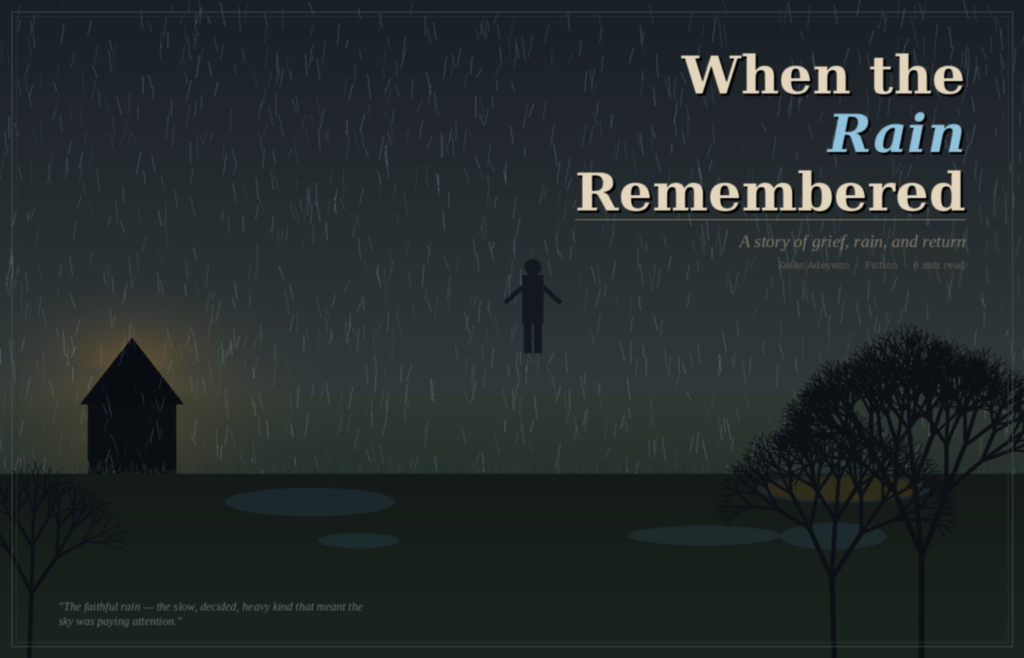
Dayo stood at the window with her coffee going cold and felt seventeen years leave her at once, the way a held breath finally releases.
She had forgotten the feeling of being rained on and feeling connected.
She put down the coffee. She opened the back door. She walked into the garden in her house shoes and stood in the faithful rain until she was soaked and crying and laughing and none of those things and all of them.
The Boat Named Patience
His skiff was small and sun-bleached and leaked a little near the bow. He had patched it so many times it had become something new, though he still called it by the old name: Sabr. Patience. His wife had named it thirty years ago. He didn’t rename the boat after she died twelve years ago. What was the point?
He left the harbor at four in the morning, before the younger fishermen, before the vendors, before anyone who might ask him how yesterday had gone.
The stars remained visible. In the old days, he had navigated by them. Now he navigated by something less nameable, a knowledge in the body accumulated through repetition, the way a musician’s hands know where the notes are without being told. He headed deep. He ventured further than the others.
The Pull
The line ran out just before noon. He felt it before he saw it, a pull so sudden and so massive that the cord cut into his hands before he could brace. He wrapped it around his back the way his father had taught him. He leaned into it. The boat turned south, then east, then south again, dragged by something he could not see. This cycle went on for a long time.
The sun moved across the sky with an indifference he had long since stopped taking personally.
He did not eat. He did not let go.
You are killing me, he thought, not with despair, but with the mild observation of a man taking stock. But you have the right to try. I have the right to try, too.
The Fish
By nightfall, his hands were bleeding. He rinsed them in the sea, which stung, and he kept his grip. In the dark, the fish became mythological, a presence below him, patient and enormous, pulling him toward somewhere it had decided to go. He thought of every large fish he had caught in his life. He thought of his wife, who used to say, “The sea takes what it wants.” Give it willingly, and it gives back. He had never fully believed her. He believed her more now.
On the second morning, the fish surfaced.
He had never seen anything like it. The fish, which was longer than the boat and resembled a broadbill swordfish, shimmered blue-silver in the early light, and moved with such force that it appeared less like swimming and more like the sea itself making a decision. Khalid looked at it for a long time.